MLB Pre-Spring Training Predictions for the Season

The 2016 MLB season ended in a way no season had ended in 108 years, with the Chicago Cubs on top as the World Series Champions. After a long offseason of free agency and a couple blockbuster trades, Spring Training is finally right around the corner. With that, we have a an idea of what every team’s roster will look like come Opening Day, which means that we can finally do what us fans love to do in making predictions so that by the time October rolls around, we can turn to our friends and say, “I told you so”.

National League Division Winners

East- Washington Nationals
Expect Bryce Harper to have a much anticipated bounce back season, and adding Adam Eaton showed us all that the Nats are in win now mode.

Central- Chicago Cubs
It would be hard to believe that someone could take the Central crown away from the Cubs this season. We hope to get a full season out of Kyle Schwarber, and the addition of Wade Davis will fill Aroldis Chapman’s spot in the 9th.

West- San Francisco Giants
The Giants’ prevalence in this decade may be over, but adding Mark Melancon in the back of the bullpen to pair with the Giants’ rotations gives them a great chance to end the Dodgers streak of four straight NL West titles.

Wild Card 1- St. Louis Cardinals
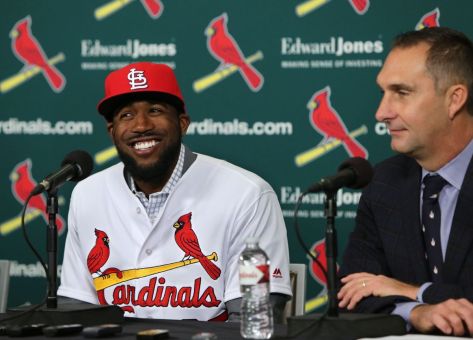
Adding Dexter Fowler to replace Matt Holliday makes the Cardinals a littler young and a whole lot more athletic. Expect them to make some noise as they usually do.
584ae5821b723.image.jpg

Wild Card 2- Los Angeles Dodgers
It’s tough to keep this team out the playoffs with the depth of pitching they have, along with young superstar Corey Seager. Clayton Kershaw in a one game playoff? Yes please.

American League Division Winners

East- Boston Red Sox
Adding Chris Sale to the already talented roster of the defending AL East Champs makes this a no brainer. The dominant pitching, paired young superstars all over field will make Sox fans quickly get over Big Papi’s retirement.

Central- Detroit Tigers
The Tigers had a bit of a down season last year, but expect guys like Miguel Cabrera, Ian Kinsler and Jordan Zimmerman to all have bounce-back seasons and bring Detroit into playoff contention.

West- Texas Rangers
A full season of Yu Darvish paired with Cole Hamels gives the Rangers a nasty two-headed ace.  Jonathan Lucroy is also back for another season, giving the Rangers a great chance to repeat as AL West champs.

Wild Card 1- Cleveland Indians
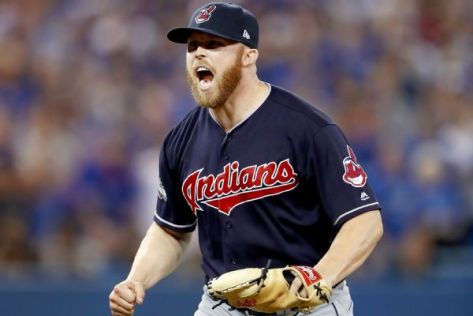
It’s hard to keep the defending AL pennant winner out of the playoffs, but it will be interesting to see how Terry Francona uses Andrew Miller and Cody Allen out of the bullpen during the regular season. The Indians are hungry for some more playoff action.
r142590_600x400_3-2.jpg

Wild Card 2- Seattle Mariners
After falling short of a wild card spot last season, the Mariners spent the off season adding pitching and outfield depth to their roster. Adding the likes of Drew Smyly, Yovani Gallardo, and Jarrod Dyson, this may be the year that the Mariners get back to the postseason for the first time since 2001.

Manager of the Year (MOTY)

National League- Bruce Bochy
The addition of Mark Melancon gives Bochy a solid man in the back of his bullpen. With this acquisition, Bochy can move other pieces around in the bullpen to bridge the starters and the closer more effectively, on the road to capturing the NL West crown and the MOTY award.

American League- Brad Ausmus
After missing the playoffs last season, expect Ausmus to get his veterans back on track this season and win the Central division over the defending American league champion Cleveland Indians.

Rookie of the Year

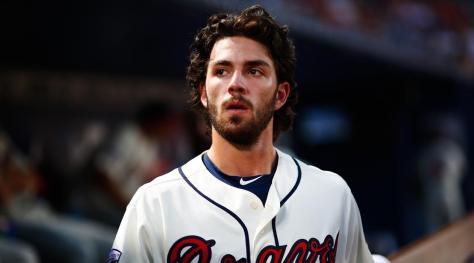
National League- Dansby Swanson
The former #1 overall pick logged 129 at bats last season, leaving him one at bat short of qualifying for rookie status in 2016. Now, in 2017, he will get the chance to play 160 games at shortstop, and if his numbers are anything like his 2016 sample, expect him to run away with it.
dansby-swanson-injury-braves-bad-throw.jpg

American League- James Kaprielian
Who? The Yankees 2015 first round pick out of UCLA likely won’t break camp in the big leagues, with the likeliest option being that he starts 2017 in AA. However, with the Yankees pitching staff filled with injury-prone and unproven pitchers, expect to see Kaprielian well before September call-ups. 

CY Young

National League- Madison Bumgarner
If the Giants want to make a deep run in 2017, they’ll need Mad Bum to be the dominant pitcher we know he can be. After a somewhat down year with only 15 wins, expect him to come into 2017 and flirt with 20 wins all while keeping his ERA down in the 2.7s.

nqkdnkchism4lkwnawmc.jpg

American League- Chris Sale
Expect a big season out of Sale in his first stint in Boston. The dominant southpaw will, for the first time in his career, have run support and expect him to take full advantage of it in 2017.

Most Valuable Player (MVP)

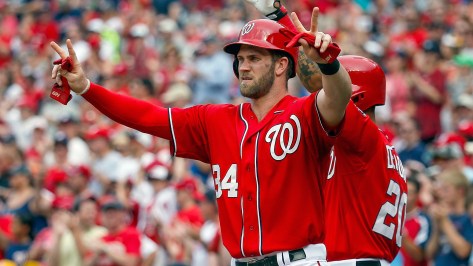
National League- Bryce Harper
Despite a very much a down season for the young superstar, look for Harper to put up similar numbers to his 2015 campaign and take home the league’s Most Valuable Player award for the second time in three seasons.
bryce-harper-012816-getty-ftrjpg_7xu3ui6e3g5k1ekjw4rzz32qo.jpg

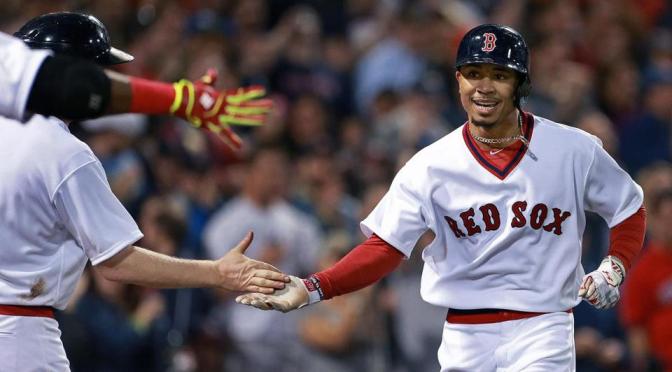
American League- Mookie Betts
After a monster season in 2016, and finishing second in the MVP voting, expect Betts to continue to grow as a player and take home the hardware as the AL’s best player. Betts will lead his Red Sox teammates to the playoffs and onward. 

Pennant Winners

National League- Washington Nationals
With Harper returning to MVP form and the other pieces the team has to offer, the Nats can reach their first world series since moving to Washington. Things are looking up for the Nationals.

American League- Boston Red Sox
With a rotation that features two aces along with the reigning CY Young award winner, it is going to be tough to hit against the Sox. Putting with their high powered offense into the mix makes it hard to imagine that the Sox don’t make it back to Series as long as everyone stays healthy.

World Series Champion- Boston Red Sox
As long as everything goes as planned in Boston, they’ll win 100 plus games, and the city of Boston will have another ticker tape parade come October/early November.
The Domination of UConn Women’s Basketball and Why You Haven’t Heard of It

As a little girl, I sat in the stands of Pauley Pavilion for almost every UCLA home basketball game. I can remember how the cement floor had shiny flecks embedded into its surface that made it look like you were walking on stars. I remember the announcer’s voice booming, “first personal, third team foul” over the speakers. I remember the malt ice cream. I remember the Bruin Bear. And I remember John Wooden. To me, he was the old man with a cane who sat at the end of the bleachers behind the UCLA team with his legs neatly crossed. To to everyone else, he was a pseudo god, the father of basketball, an idol. I saw how my father admired him, and by the transitive property, I admired him too. As I write, a Wooden-signed basketball sits above me on my shelf, serving not only as a symbol of athletic prowess, but also as a symbol of the morals and values taught to us by Coach.

In 2010, in the midst of the basketball season, the University of Connecticut Women’s basketball team was closing in on UCLA and Coach Wooden’s NCAA record of 88 consecutive victories from 1971-74. Amidst a slurry of public unhappiness from old players, coaches, and fans, John Wooden’s daughter imparted us with her father’s feelings on the subject: “He thinks they play the purest form. He really likes the way they play. Most of the women’s teams play below the rim and there’s a lot of teamwork. He liked that. He really liked that.” Unfortunately, Wooden passed before the game could be played, but his grandson, Greg Wooden, was at the game where UConn broke the long-standing record. He said, “in the last decade of his life, coach Wooden thought the best basketball was being played at the collegiate level, and it wasn’t by the men. [He] believed that women’s teams, especially Connecticut, were playing his style of basketball, and liked the way they emphasized team above all else”.

So, Women’s basketball gets the seal of approval, recognition from the god of basketball himself; a blessing of sorts. That should be enough to earn the respect of the masses, if not at the very least the respect of aficionados of the game. Wrong.

The Streak

pic1

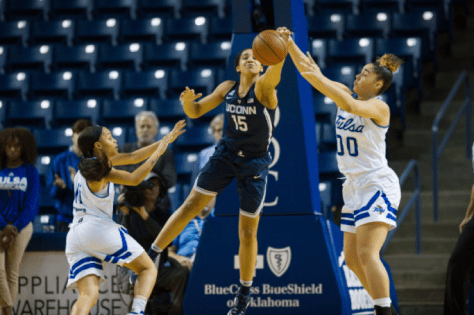
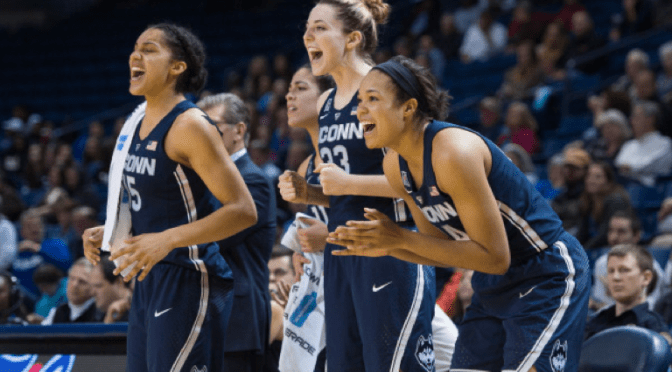
Since the inception of UConn Women’s basketball in 1975, the Huskies have amassed an astounding .779 win percentage– the third highest in history, trailing only Tennessee and Louisiana Tech respectively. If we isolate just the last five years of UConn basketball, they have earned a .948 win percentage and have only lost five games in total. This is the single highest win percentage in Division I women’s basketball for these years. Every year, they seem to be improving, both in overall record and quality of play. This may be in part due to head Coach Geno Auriemma’s ability to recruit the best of the best. They are an athletic force that seems to be unstoppable. So far in the 2017 season, the UConn women are 16-0, are ranked number one in the nation, and are the four-time defending national champions.

As of Monday, January 30th, the Huskies have won 95 straight games, shattering their old record of 90 consecutive victories from November 2008 to December 2010 (the same year they broke the NCAA record previously held by Wooden’s UCLA team). In fact, UConn hasn’t lost a game since November 17, 2014 when they lost to sixth ranked Stanford in a nail-biter that pushed into overtime. Even more still, the Huskies have not trailed in points behind another team in about 374 minutes. They have literally been ahead of the game since December 11th. That’s unreal.

Cash, Competition and Coverage

pic2

In general media, there is a huge disparity in coverage of women’s basketball and men’s basketball. If a reader were to flip to the edition of the New York Times during March Madness last year they would see the men’s NCAA Basketball tournament’s Final Four teams front and center. If they looked deeper into the edition, they would find a short article and a photo of the women’s teams in the sports section (which included the 2016 UConn team). According to a study conducted by the USC Center for Feminist Research in 2009, 96% of sports news is dedicated to men and 2% of network news and ESPN SportsCenter coverage is devoted to women. While outrageous, such a huge disparity is produced for a very legitimate reason. People aren’t watching. Funding for streaming games, network time, and promotion goes where the audience is, and the audience is watching men’s basketball. The power to dictate where the money goes and what programs get media exposition lies in the hands of the consumer. There is even a disparity in the treatment of their various athletic programs in Universities. While over the years the economic gap has narrowed, according to the 2014 NCAA Sports Sponsorship and Participation Rates Report, male athletes still receive 55% of NCAA college athletic scholarship dollars (Divisions I and II), while women only receive 45%. In addition, according to the Gender Equity Report by the NCAA in 2012, women’s teams receive only 40% of college sport operating dollars and 36% of college athletic team recruitment spending at the Division I level. This disparity comes down to ticket sales. The Women’s games are just not selling. According to NCAA statistics, in 2016, 27,234,610 people went to a collegiate DI basketball game and 8,286,356 people attended a DI Women’s basketball game, which was an all time record high. The tickets are not selling, so the universities are not funding. Plain and simple.

So why aren’t people watching? Professor Dale Spencer authored a book entitled Ultimate Fighting and Embodiment: Violence, Gender, and Mixed Martial Arts, in which he explains the disparity in women’s sports and men’s sports in terms of engagement with the public. He says, “There’s a general attitude in relation to women’s sport and what leads to the lack of viewership is the fact that women’s sports aren’t at the caliber of men’s sport. Therefore, it’s not worthy of being watched, and there’s this bigger, stronger, faster mentality”. This idea permeates our culture. A quick poll of the men and women I personally interact with on a daily basis produced the same attitude. I hear time and time again, “it’s boring. It’s just not as exciting as the men’s game. The men are quicker and stronger”. I talked to one female collegiate basketball player who explained, “people want to go to games and see someone dunk and, just due to biology, girls aren’t doing that so more people are going to go to men’s games. They’re ‘more exciting’ to a certain degree because of the pace and athletic ability, which we have no control over as women”. However, as Coach Wooden so eloquently explained to us in 2010, the female athletes of today are playing a different kind of basketball; a game characterized by finesse, technique, and teamwork on the floor.

In the 60s and 70s, men and women were playing a similar game. The NCAA had banned dunking in collegiate games for a variety of reasons and Kareem Abdul-Jabbar of UCLA was one of a handful of men to develop and execute the skill. However, post-ban, the dunk became a regular part of men’s basketball and people LOVED it. The public has come to crave those so-called “highlight plays”; the breakaway, the dunk, the chase down block. Sydney Bennett, a member of the Redlands University Women’s Basketball team says, “is it simply less exciting to watch a female run up the court and meticulously plan her every move in a sea of defenders compared to her counterpart who will dunk for their two points? What makes a great team is consistency, pace, and maturity. Fans don’t care about these concepts though. They want to see fast and flashy ball where dunks are the new layup and half court swishes are the usual”. The popularity and excitement surrounding highlight plays effectively creates a disinterest in the women’s game. After all, very few women in history could dunk the ball (Brittney Griner being one of the most recent women to do so).

While many people aren’t necessarily watching women’s basketball, they are watching other women’s sports including Women’s Tennis and MMA (Mixed Martial Arts). This bares another question: Why is the public watching these sports over others? Professor Dale Spencer explains that it comes down to the hyper-sexualization of athletes: “Tennis and MMA have been able to hyper-sexualize the women who participate in those sports, especially when they already have a certain physical appeal going for them. They’re able to really promote those women and maintain a level of popularity that is roughly equivalent to the male side of the sport, which isn’t necessarily a viable strategy in certain other sports because they aren’t able to shine the spotlight on a single person in the same way”. Whether conscious or subconscious, some of the popularity associated with these sports has to do with the hyper-sexualization of women such as Ronda Rousey and Serena Williams. Basketball is not privy to the increased viewership that comes with the hyper-sexualization of the female body in individual sports. One of the few exceptions to this theory occurred when professional basketball players, Diana Taurasi and Seimone Augustus kissed on the court, increasing viewership and earning them matching personal fouls.

In a blatant display of sexism, one fan commented on the kiss: “The WNBA is on to something here. More kissing will definitely lead to higher ratings from the coveted male 18-39 age group. Also, anyone committing a foul has to remove an article of clothing. The league could eclipse the NFL in popularity”……….. excuse me?

Watch a Game and See for Yourself

While this may sound like a sad data dump of facts that support the notion that women are just not getting the same exposure in sports as men are, there is hope. During March Madness and especially during the Final Four, there is a huge spike in viewership of women’s collegiate basketball that rivals that of the men. As one collegiate female basketball player explains, “I would imagine that women’s basketball is the most televised and publicized NCAA Women’s sport simply due to March Madness, and I would say that of the NCAA Women’s Basketball teams, UConn by far has the most exposure especially among the people I know that care a lot about basketball”.

So for now, we can settle with basketball enthusiasts recognizing that UConn Women’s basketball is ridiculously dominant, but how do we take it one step further and try and change the culture? We can take two basic actions (although there are probably many other things we could do):

  1. Attend women’s college and WNBA basketball games. Many professional teams have discounted student tickets and deals for families and many Universities have very small admissions fees if not free admission. With increased ticket sales comes increased funding for collegiate programs. Not to mention, athletes feel the love and support from fans in the stands.
  2. When games are aired on television channels such as ESPN, WATCH. If you like sports and you enjoy basketball, watch these women play. Observe their technique. Study the plays. I promise that you will enjoy. Networks are monitoring ratings and viewership and women’s sports will get more airtime if we increase the amount that we watch.

Collegiate athlete Sydney Bennett goes on to say, “I don’t think women’s basketball is any less entertaining, it is just different entertainment. You have to appreciate the sport to love women’s basketball […] I think it’s really sad that women’s sports aren’t as exposed because we sacrifice and endure just as much pain and struggle to be the best as men. I feel like women’s athletics has been oppressed and only time will give us the opportunity to prove what every female athlete already knows. We do deserve recognition and attention for our performances”.