
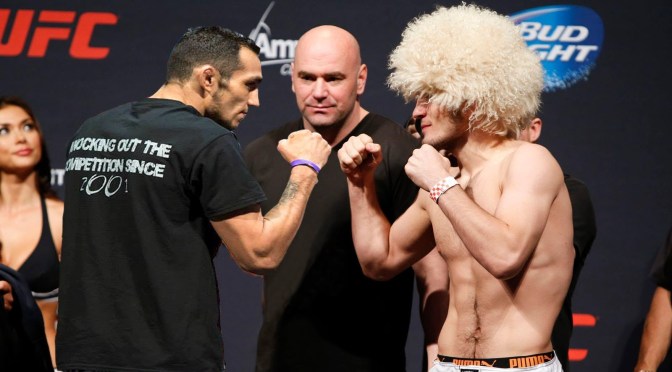
Oh yeah. It’s finally happening. After being arranged and then cancelled twice in the past, Tony Ferguson vs. Khabib Nurmagomedov has been made to happen for the interim Lightweight Championship on March 4, 2017. Two of the baddest men on the planet at 155 pounds will go at it in the Octagon for five rounds of five-minutes to determine who will be the interim lightweight champion and, of course, the recipient of one of Conor McGregor’s famous ‘Red Panty Nights’.
The background to Nurmagomedov vs. Ferguson is so perfect that the WWE’s writers could not have crafted a better story. Tony Ferguson is a skinny, lanky lightweight who has been on an unprecedented nine-fight win streak in the UFC, while Nurmagomedov, the Russian Sambo champion and master grappler, is 8-0 in his fights in the UFC. In fact, Nurmagomedov has never lost an MMA match, with a total record of 24-0 in MMA bouts. The first time they were scheduled to fight, Nurmagomedov was forced to pull out due to injury, and the second time they were scheduled to fight, Ferguson pulled out for the same reasons. So, at long last, the matchup has been made and the stage has been set. What can we expect to see when these two monsters clash in the Octagon?
Striking
In the realm of striking, to the untrained eye, it would seem that Ferguson can crush Nurmagomedov easily. After all, Khabib doesn’t ever seem to throw a straight punch, opting for wide, looping punches instead. Tony, on the other hand, uses his skinny, lanky frame to maximum effect, forcing his opponents to stay at range and pressuring them while moving forward.
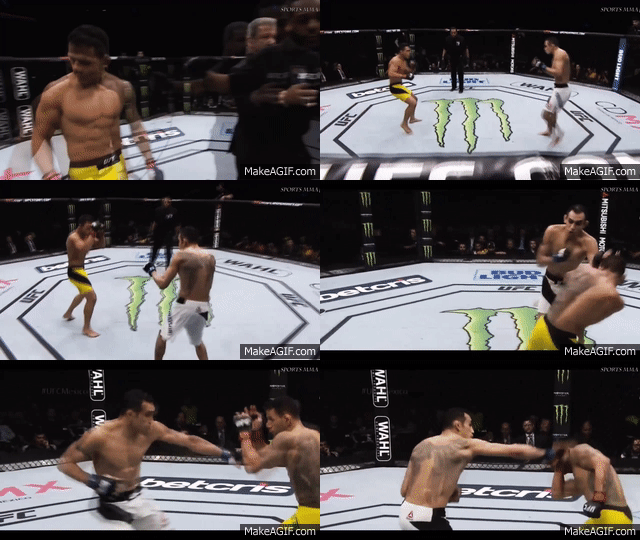
In the above gif, we can see Ferguson pressure his opponent, fellow pressure fighter and former UFC champion Rafael Dos Anjos, utilising his superior reach to maintain distance with his opponent, while also creating angles in order to land his shots. The gif also gives us an idea of Ferguson’s versatile striking game, which includes a variety of kicks and punches.
Too many analysts seem far too quick to dismiss Khabib’s ability in the striking department. It is undoubtable that if one were to look at the skills displayed on their own, Ferguson would have the standing advantage. However, Khabib’s striking is practiced and effective in getting his opponent to do what he wants them to do. Khabib’s main goal is to pressure his opponent into moving back against the cage so that he can more fully utilise his takedown game. The cage is especially useful for Khabib when fighting high level wrestlers or grapplers, as it allows him to pin his opponents and work on a takedown without having to worry too much about his opponent trying to escape. In this sense, Khabib’s striking does exactly what it was built to do.
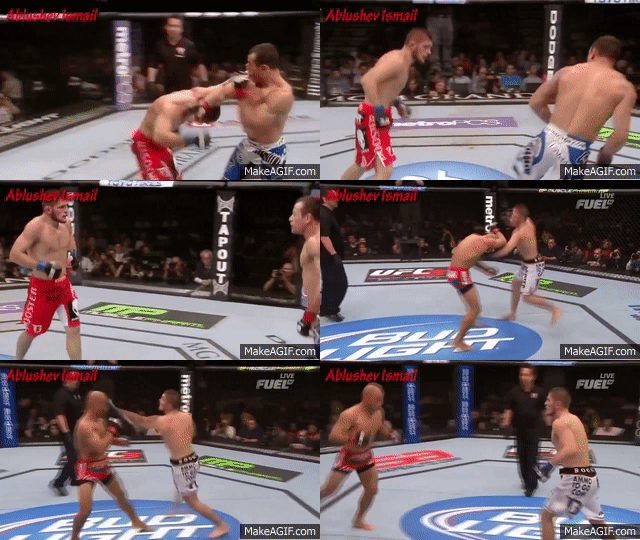
As shown in the gif above, Khabib’s wild strikes and fast forward movement causes his opponents to retreat straight backwards. As a result, opponents often find themselves with their back against the cage and Khabib around their legs.
Therefore, we can say that one of the crucial factors in the striking exchanges will be which fighter is able to pressure the other one more effectively. While Ferguson’s striking ability feeds off of his pressure, Khabib simply wants to pressure his opponents to get them against the cage. Here, he can force them into a clinch, where he can work his myriad takedowns to bring his dominant grappling into play.
Obviously, one could go into much more detail about the specific weapons each fighter uses in order to achieve these main goals (from Khabib’s hooks to Ferguson’s straight punches) but suffice to say, the success of either fighter’s stand-up abilities can be measured in whether they are able to push their opponent backwards. In this sense, one can guage who is applying the pressure on who within the fight.
Grappling
If the striking between Khabib Nurmagomedov and Tony Ferguson creates an interesting interplay of competing and contrasting skills, it could be argued that the clash of their grappling skills are even more exciting. Until this point, Khabib Nurmagomedov has looked almost flawless in his grappling performances. He has maintained positional dominance whenever the fight hits the canvas, and seems to catch his opponents off guard with his grappling strength. In his fight against Abel Trujillo, an accomplished wrestler in his own right, Khabib set the record for the most takedowns in a UFC fight, bringing his opponent to the canvas a total of 23 times
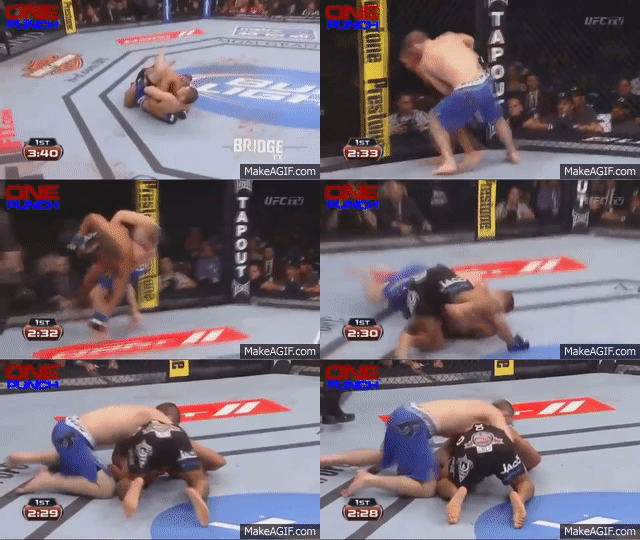
As seen above, Khabib maintains his positional dominance while hitting a phenomenal suplex takedown on Trujillo. For any other fighter, this would be their number one highlight of the night, but for Khabib, this was just one of the 23 masterful ways he drowned his opponent against the mat. One of the beautiful things about Nurmagomedov’s takedowns is that he doesn’t land in the traditional jiu-jitsu guard position like most other wrestlers. Instead, Nurmagomedov’s takedowns put him in more dominant positions, thus bypassing the guard, one of the most dangerous positions for grappler on top. Once he has taken his opponent down, Nurmagomedov opts to maintain positional dominance rather than to attempt submissions and hit his opponent while they are pressed against the floor.
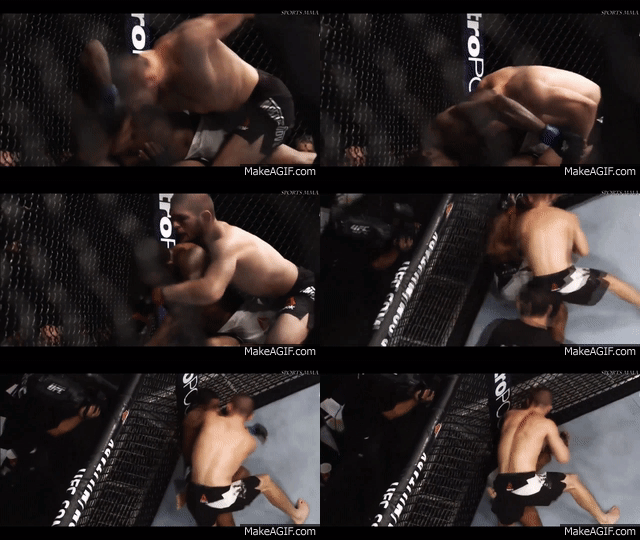
One of the best examples of this style is from Khabib’s most recent fight (the gif above) where he beat up Michael Johnson from dominant ground positions for three rounds while whispering in his ear that he should give up. In this sense, Khabib’s grappling has not been challenged enough, and is the main secret to his undefeated streak. His ability to control opponents and beat them up on the ground is absolutely unprecedented. However, Fergusons grappling has some interesting features that could pose a serious problem to Nurmagomedov.
The first unique feature is Ferguson’s approach to defending takedowns. If Khabib is all about maintaining positional dominance in order to land effective strikes while forgoing traditional submission attempts, Ferguson will purposely put himself in bad positions in order to avoid an immediate threat.
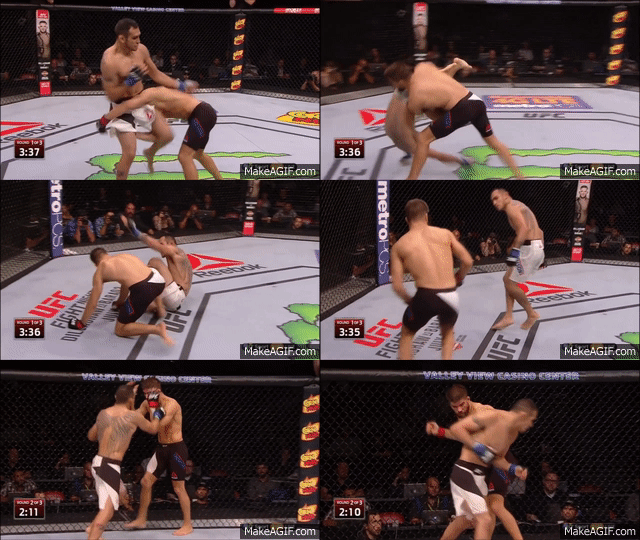
As seen in the above gif, in order to avoid being taken down, Ferguson tries to roll out of the double leg. This is a risky move because being caught in the wrong moment, could mean he could have given up his back, and be in a much worse position than if he got taken down. However, this willingness to put himself in bad positions adds to Ferguson’s unpredictability and shows his confidence in his grappling skills. In fact, Ferguson has displayed slick submission skills, as he is known for his use of the D’Arce choke. What makes the D’Arce choke and specifically Ferguson’s D’Arce choke so unique is the variety of positions in which it can be applied. The choke can be applied from a standing position, but can also be applied from traditionally disadvantageous positions such as from a under side control or from the bottom of half guard. As a result, Khabib will have to deal with the constant threat of Ferguson’s jiu jitsu, and prove that he can maintain positional dominance against an opponent known for their offense off of their back.
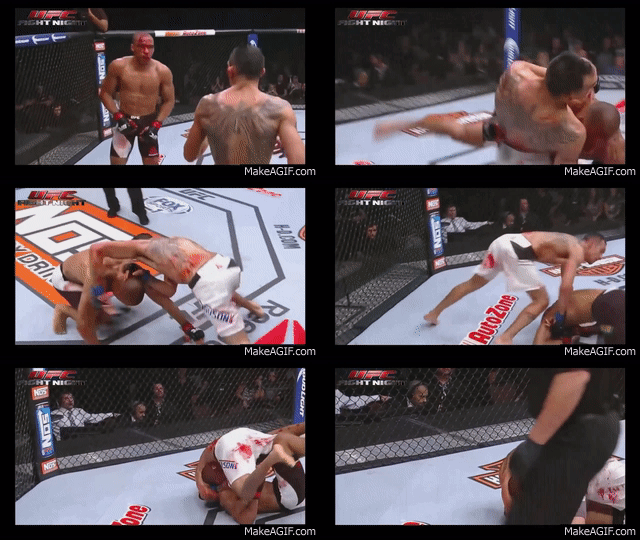
In the above gif, it can be seen how this poses a problem for a wrestling-heavy style like Khabib’s. If Khabib ducks his head in for a takedown and isn’t careful, Ferguson can lock in the D’Arce and finish the fight. This means that Khabib will be restricted to upper body takedowns if he plays it safe. This also means that Ferguson is a major threat to Khabib in the area in which he is most dominant, namely, his grappling.
Conclusion
Forget the 24-0 record and the 9-fight win streak and the 2 cancelled fights for a second. All things considered, Ferguson vs. Khabib is not just an interesting fight because of the pre-fight context. Instead, the two fighters’ skills compete and contrast naturally to create an interesting dynamic for the fight. Just like any other fight, we never know the outcome until the fight is over. Khabib could come out with a spinning headkick that knocks Ferguson out in the first round, but we can only comment on the skills the fighters have displayed and the challenges they pose to their opponents. Usually, this is sufficient analysis to give us an idea of where the fight will take place or how the fight might look. With that being said, there is too much to cover in any one fight for an analysis to ever truly be complete. We did not look closely at the strategy of Khabib’s winging hooks or at Ferguson’s subtle feints, among other strategies within the fight; instead, a basic framework has been provided with which anyone can watch and analyse the fight. Who is moving forward? Who is taking it to the ground? Who is on top? Is Khabib getting trapped in submission attempts, or is Ferguson being pinned to the floor? How does Ferguson deal with Khabib’s unorthodox striking pressure? How does Khabib deal with Ferguson’s? With this basic understanding of the fight and the fighters, the hope is that it lays bare just the surface of MMA strategy. Regardless of whether the whole world was watching as if it was a McGregor fight, one can still tune in to see an artful display of skill, strength and the human spirit at UFC 209 on March 4th, 2017.


 Banter Sports