The Generational Rivalry that Changed Tennis and Defined the Greatest of All Time

The Western and Southern Financial Open in Mason, OH is a Masters 1000 and US Open Series ATP and WTA tournament. In other words, “Cincy Tennis,” as it has been dubbed, is the largest tennis tournament in the country behind the US Open. It hosts some of the greatest tennis players in the world.

For the past 10 years, my family has headed down to Cincinnati for a spectacular showing of tennis and an equally spectacular helping of the local chili. It was on Court 9 where my brother and I were the only people in the stands during an epic three-set match between Stanislas Wawrinka (current world #3) and Tommy Robredo (highest world ranking #16). It was at the food court where we casually ate lunch with Chair Umpire Fergus Murphy. Best of all, it was on Center Court where I stood in the presence of the two greatest male tennis players of all time: Roger Federer and Rafael Nadal.
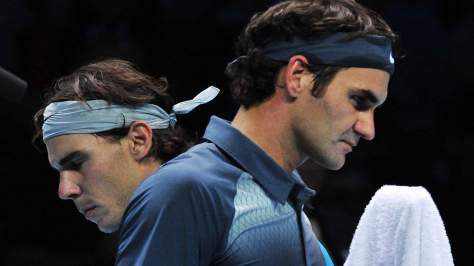
promo208383845-1416667143.jpg
Nadal (left) and Federer (right).

Cincy tennis is a part of me; it’s where I fell in love with the sport and where I fell in love with the culture. However, it would be a lie to say that the two greatest tennis players of all time did not have a hand in making me fall in love with tennis each time they stepped out onto the court.

Roger Federer:                                            Rafael Nadal:

Age: 35                                                              Age: 30
Country: Switzerland                            Country: Spain
Turned Pro: 1998                                        Turned Pro: 2001
Career Record: 1087-245                      Career Record: 814-176
Career Titles: 89                                         Career Titles: 69
Grand Slam Titles: 18                             Grand Slam Titles: 14

Comparing the basic statistics side by side, it seems obvious that Federer is the greatest player of all time. No other male player in the history of the sport has won 18 Grand Slam Titles. And yet, it is Rafael Nadal who holds the record for most Roland Garros titles, completed a Career Grand Slam, and won two Olympic gold medals. And since first playing each other in 2004, Rafa leads the head-to-head 9-3 in Grand Slams and 21-13 overall.

In the past three years, both players have struggled with injury and have fallen from former glory. Today, Federer is ranked 9 in the world and Nadal is ranked 6.

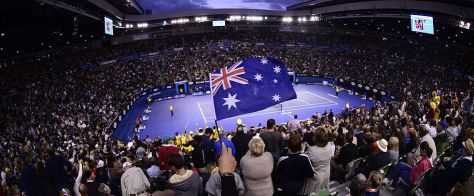
On January 29, 2017, the Former World No. 1s took to Rod Laver Arena for the finals of the Australian Open. Seeded 17 and 9 respectively, nobody expected either Federer or Nadal to make it to the final. Novak Djokavic (current world #2) and Andy Murray (current world #1) both lost early, and Federer and Nadal rose to the challenge. They easily defeated some of today’s top players: Milos Raonic (current world #4), Kei Nishikori (current world #5) and Grigor Dimitrov (current world #12).
910341_fac7711446f84c9a8718c87d969bb684.jpg

In the end, at the age of 35 (an anomaly among high-level professional tennis players), it was Federer who took home the trophy, defeating his greatest rival 6-4 3-6 6-1 3-6 6-3. Although Federer won the title, again looking closely at the statistics, it is surprising to see that Rafa has unimaginable stats for someone who lost the match.

stats.png
Statistics acquired from IBM Slamtracker.

Many said that the winner of this match would be solidified as the greatest tennis player of all time, and yet the statistics still question this.

So who is the greatest player of all time? The one with the most titles or the one with the lead in the head-to-head and the Career Grand Slam?

My opinion: Rafa is the greatest clay court player of all time but the true answer to this question was solidified years ago in Mason, Ohio the first time I ever watched Federer hit a backhand winner on center court all those years ago.
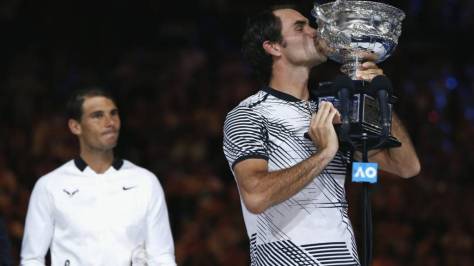
_93858796_rogerfedererkissesthetrophy_reuters.jpg
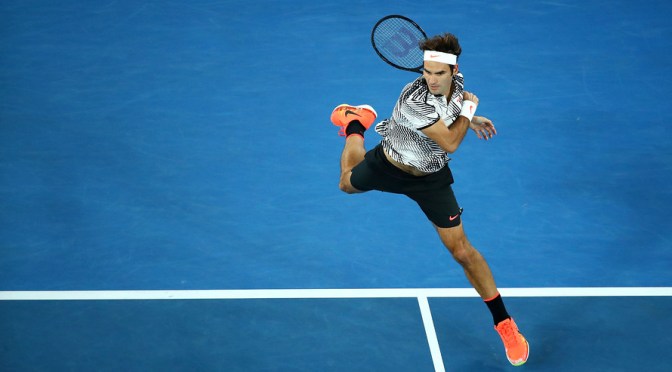
Federer celebrating his victory over Nadal in the 2017 Australian Open Final.

The Evolutionary History of Foreign Players in the Chinese Super League

The Chinese Super League (CSL) has recently aroused the attention of the soccer world for the expensive players recently purchased from mainstream European soccer leagues. These players who take their talents to China are mostly at their golden age and play for a decent team in Europe. Generally speaking, the main reason for these talented players to be convinced to play in China is for money. However, the CSL is trying to build a top league in Asia or even in the world, basically out of nothing, by bringing in these talented players. The main focus of the media is often geared towards looking at moves to China through the eyes of the players themselves rather than the Chinese organizations, leading to a bias that portrays Chinese soccer in a bad light.

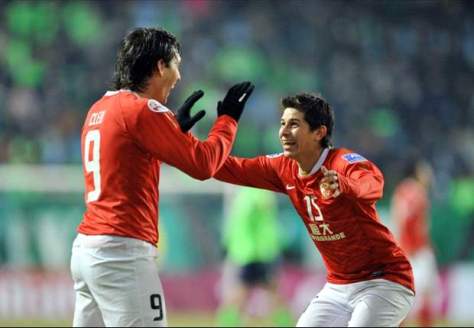
The trend of attracting world class players started in 2011, when Guangzhou Evergrande bought Dario Conca from Fluminense for $10 million. Conca was the MVP of Campeonato Brasileiro Série A in 2010, and he made a splash upon his arrival in China. He scored 53 goals and assisted 35 times in 100 matches while playing for Guangzhou Evergrande. With Conca’s outstanding performance, Guangzhou Evergrande became CSL champions three times in a row, and even won the AFC (Asian Football Confederation) Champions’ League in 2013. Conca went back to Fluminense in 2014’s winter, but came back to China again one year later. Shanghai SIPG, a new force in CSL, bought Conca for $10.4 million due to his fantastic performance during his time with Guangzhou Evergrande. Earlier in 2017, Flamengo took Conca on loan from Shanghai SIPG for one year, leaving his ownership to Chinese clubs.

174804_heroa.jpg
Conca (15) celebrating a goal with a teammate.

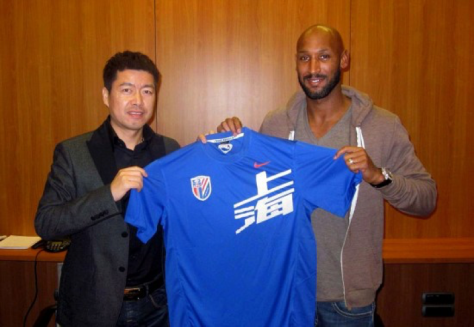
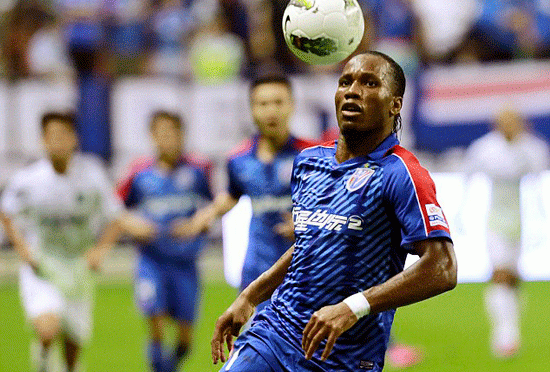
2012 was also a striking year for CSL, especially for Shanghai Shenhua FC, as they bought two world-class players from Chealsea FC, French striker Nicolas Anelka and Didier Drogba from Cote D’lvoire. Drogba is still the best foreign player to ever play in CSL, as he has won both the Premier League title and the UEFA Champions’ League.

anelka.png
Anelka being introduced for Shanghai Shenhua FC.

Costing huge sums of money, Anelka only scored three goals during his time in Shanghai Shenhua, and didn’t get along with the manager. On the other hand, Drogba showed his ability of being a top striker, with eight goals and two assists in the only eleven matches he played while having already eclipsed his prime. Three months after Drogba’s arrival, news of wage conflicts between Shanghai Shenhua and Drogba surfaced, prompting his departure from the club.

Whether or not these international acquisitions panned out, these were all just a start. In 2014, with Italian World Cup Coach Marcello Lippi becoming the coach of Guangzhou Evergrande, he started to buy Italian strikers to bolster the team: Alessandro Diamanti and Alberto Gilardino. However, their short time in China proved to be relatively unsuccessful, as both of them left Guangzhou Evergrande in less than a year.

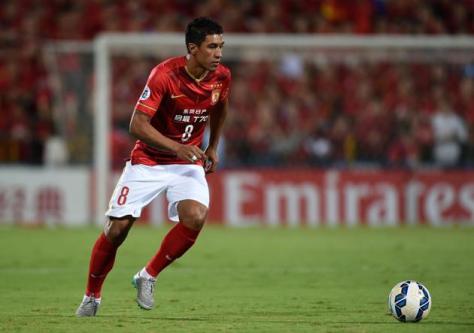
Guangzhou Evergrande has always been the leader in using big sums of money to attract foreign players to take their talents to China. In 2015, the team bought Brazilian central defensive midfielder Paulinho, from Tottenham Hotspur for 14 million Euros. Paulinho was a proven starting caliber player for a strong club in the Premier league, and he was still relatively young. The transfer seemed crazy at the time, but it was just the prelude to the craziness that was to follow in 2016.

paulinho.jpg

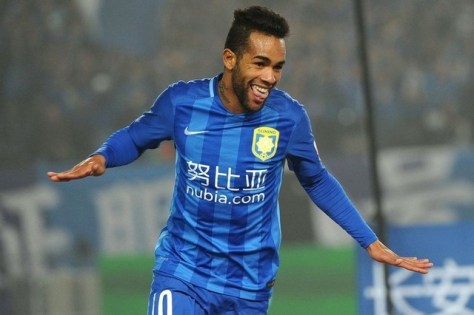
More big purchases jumpstarted in January of 2016, and this time, it was not just one club anymore. Guangzhou Evergrande made another big deal by bringing on Columbian striker Jackson Martinez from Atletico Madrid for the unbelievable price of 42 million Euros. Jiangsu Suning, another ambitious team in CSL, bought two Brazilian players, Ramires from Chealsea for 28 million Euros and Alex Teixeira from Shakhtar Donetsk for 50 million Euros. Teixeira’s acquisition broke the transfer fee record at that time, but it was soon broken yet again only half a year later. Meanwhile, Freddy Guarin joined Shanghai Shenhua from Inter Milan, and both Gervinho and Ezequiel Lavezzi joined a new member of the CSL, Hebei Huaxia Xingfu. This was an insane winter for Chinese teams.

&NCS_modified=20160307095548&MaxW=640&imageVersion=default&AR-160309290.jpg
Alex Teixeira’s contract made waves in the Chinese soccer world.

Starting in 2017, even more shocking transfer news came without warning when Oscar joined Shanghai SIPG from Chelsea, Carloz Tevez joined Shanghai Shenhua from Boca Juniors and Axel Witsel joined Tianjin Quanjian from FC Zenit.

With so many big stars joining the CSL, many people argue that the phenomenon is negative as so many players come to China simply for the incredibly high wages. This is true, but we can never ignore the fact that the competitive level of the CSL is greatly promoted. With Guangzhou Evergrande winning AFC champions’ league in 2013, more and more teams in the CSL are now aiming to achieve a step further than just AFC Champions’ league glory. While Guangzhou Evergrande has won the CSL championship six times in a row, other teams have been trying hard to break their monopoly. Teams like Jiangsu Suning, Shanghai SIPG, Shanghai Shenhua and Shandong Luneng spent even more money recently than Guangzhou Evergrande, aiming to become the next CSL champion.

To counter the fact that each team relies too much on their foreign players, CSL changed their policy this year: from “4+1” (five foreign players including one from Asia) to “3+1” (four players including one from Asia). The new policy decreases the reliance of each team on their foreign players and emphasizes the CSL’s desire and vision to develop Chinese soccer. Meanwhile, every team has also started to look for even better foreign players. It should no longer be surprising for star players to come to China, because both the players and the clubs realize their profits.

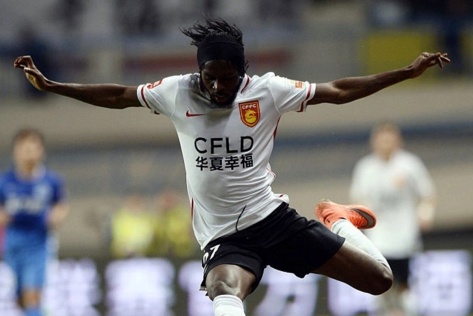
Gervinho.jpg
Gervinho playing for Hebei Huaxia Xingfu.

No one is denying that Chinese clubs that make large player purchases are so rich that they can afford any player in the world. By these means, when the CSL is included in the world soccer industry, clubs that pay the transfer fees and wages should get the outstanding players that they want if all players, clubs and parties involved agree to the acquisition. The clubs from the CSL are simply pursuing a top league in the soccer world. Money always talks a lot, but their aspirations should never be despised.