

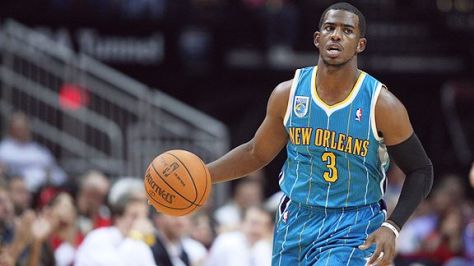
Chris Paul was my favorite basketball player to watch growing up. He could get anywhere on the court whenever he wanted to, was unselfish enough to set up his teammates and didn’t force anything. I tried to model my game after him, always working on my passing, dribbling and midrange shooting. I currently stand an unimposing five foot seven inches tall and still can’t shoot to save my life, so that didn’t necessarily go as planned.
Back to Chris Paul though, I had always felt that he was worthy of MVP honors, especially in the 08-09 season when he was the only good player on his Hornets team that he carried to a 49-win seven-seed in the playoffs. Due to my belief that Chris Paul should have been an MVP, I have always felt that the MVP should go to the best player on the team that over-performed most drastically and would have been terrible without them. For example, I thought that the NFL MVP during the 2016-2017 season should have been the Cowboys offensive line, because they were the reason that Dak and Zeke played the way they did. In the 2014-2015 season, I thought that Anthony Davis deserved the MVP because that Hornets team would have ended up top five in the lottery had he not been on the team, and instead made the playoffs over a Thunder team that was then limited to Russell Westbrook just like this season.
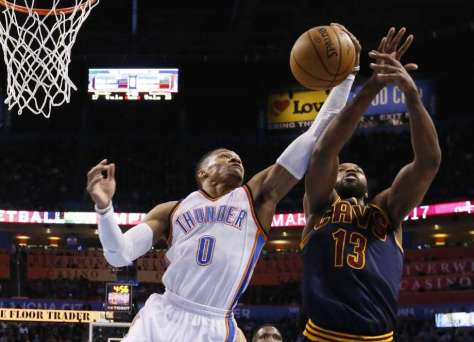
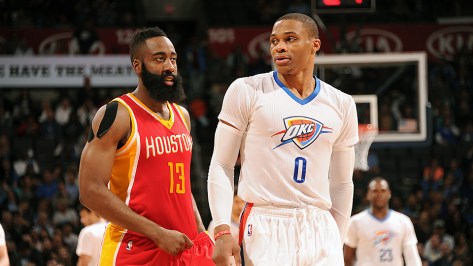
This season’s MVP award is really down to two main candidates: Russell Westbrook and James Harden. My personal opinion is that Russell Westbrook should be the MVP, but my gut tells me that James Harden will win it because of his team’s success. Westbrook plays on a team of significantly inferior talent than that of Houston and has still carried them to victory, averaging a triple double and leading the league in scoring in the process. Harden’s team has the three seed in the West, he leads the league in assists and is second in scoring, only to Westbrook. Statistically, Westbrook leads the league in points produced with 2931, but Harden leads in win shares with 15.
Here are the stat lines for each of our two major candidates:
| Wins | PPG | APG | RPG | SPG | BPG | TPG | FG% | 3P% | FT% | |
| James Harden | 55 | 29.1 | 11.2 | 8.1 | 1.5 | 0.5 | 5.7 | 44 | 34.7 | 84.7 |
| Russell Westbrook | 47 | 31.6 | 10.4 | 10.7 | 1.6 | 0.4 | 5.4 | 42.5 | 34.3 | 84.5 |
From a basic perspective, both players have had incredible scoring and passing seasons and neither of those statistics can be utilized to differentiate the two of them. Rebounding, though, has a wider margin. Westbrook rebounded at an incredible rate for a point guard, despite the fact that Steven Adams and Enes Kanter are both good rebounders in their own right. While Harden was a great rebounder, what Westbrook did was truly spectacular.
I decided to put this to the test by running the numbers, using every MVP’s stat line since 1980, when the 3-pt line was introduced. Given that it starts in 1980, we miss out on all of Bill Russell’s, Wilt Chamberlin’s and all but one of Kareem Abdul-Jabaar’s MVP seasons. Also, with two lockout shortened seasons in 1998-1999 and 2011-2012, the total win shares numbers were projected for those seasons based off of an eighty-two game season and the win totals for Karl Malone’s Jazz and LeBron James’ Heat were projected by their winning percentages.
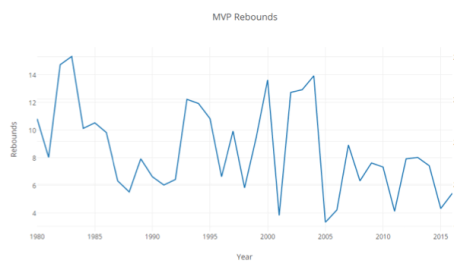
Despite this differentiation, the trend in recent MVP years demonstrates a lowered value being placed on rebounding. So, while what Westbrook did was special, the transition that the league is taking from a big man’s league to a small-ball centered league has resulted in a diminished impact on voters.
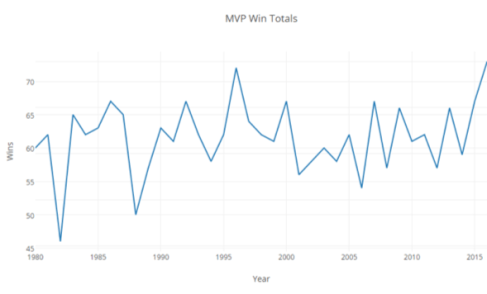 Being that wins set the MVP candidates apart more than many other statistics this season do, win totals have been a core point of discussion when thinking about the MVP race. In 2016-2017, Westbrook’s team only finished 5 games above .500. Traditionally, players on teams with higher win totals do better as the only player since 1980 to win the MVP with a win total under 50 was Moses Malone in the 1981-1982 season when he won 46 games. Russell Westbrook would be a huge exception to what has transpired in recent times, and it seems as though it would make more sense for voters to choose Harden. However, how does one account for a player who averaged a triple double the entire season? Could Westbrook be an exception to the trend, despite the fact that Oscar Robertson didn’t win the MVP when he averaged a triple double?

There is an argument to be made for each of these candidates within the two main differentiators, so with these arguments being presented, we may move to what it means to be the Most Valuable Player. Everybody has their opinion of what being the MVP in basketball means, but to me, it is the person with the biggest impact on their team. Harden led the Rockets to the biggest positive win differential against pre-season totals put out by the book makers in Vegas this season. The Rockets were given 41.5 wins and the Thunder had 45.5. Harden’s team far exceeded their number by 13.5 wins, and Westbrook’s team only over-performed by 1.5. This acts as a check for Harden. Once again, Westbrook is able to respond due to the poor shooting of his team. Both Westbrook and Harden positively impacted their team’s shooting performance from two point range as their teammates shot better off of assists from them (10.1% and 9.6% respectively). However, Westbrook is the only one who positively impacted his teammates on a three-point shooting capacity in an increasingly three point shooting league. Despite this, Harden’s teammates shot 8.3% better than Westbrook’s teammates on wide open thees, leading to a record-setting three point shooting season for the Rockets. This can partially be credited to the fact that GM Daryl Morey has built a team completely designed to shoot the three and to make layups.
So, who is the MVP this year? According to my theory, while it is my strong opinion that Russell Westbrook had a greater positive impact on his team, based on the history of MVP voting and the impact that James Harden has made on his team this season, Harden is likely to receive this year’s trophy.


 Banter Sports