How Should we Determine a League MVP?

The award for Most Valuable Player (MVP) is always hotly debated amongst diehard sports fans and figurehead experts. The issue in doling out this award to the individual who is supposed to represent excellence in their respective league during the most recent season is how to actually decide who in fact is the “best” player.  Thus, it essentially comes down to deciphering what factors determine one to be the most valuable player out of all eligible players for one specific season. Is it an athlete’s uncanny ability to keep their team competitive and in striking distance of postseason success or is it purely an honor that should be derived from individual stats? This age-old question has constantly been interpreted in different ways throughout each professional sport.

russell-westbrook-acceptance-speech-mvp-nba-2017-watch-2feb3cc9-203e-414a-bae8-0588c1413202.jpg

I believe that while a team’s record should be noted as part of the equation that decides who will earn the MVP award, it should not be a primary aspect.  Russell Westbrook was the first NBA player to average a triple-double in a season since Oscar Robertson of the Cincinnati Royals did so in the 1961-62 season.  While one would think that Robertson would have unanimously won the MVP award for that season, he in fact came in third place behind Bill Russell of the Boston Celtics and Wilt Chamberlain of the Los Angeles Lakers.  Russell and Chamberlain played on championship-contending teams that season, while the Royals barely finished above a .500 record.  Thus, the voters in that era decided that a team’s performance in the standings mattered more than a player’s on-court contributions.  This is not to say that only stats should be weighed as a factor in deciding who the true MVP of that league is, but that one should consider how a team might perform without the player in question. The Oklahoma City Thunder are a lottery-destined team without Westbrook as their point guard.

While triple-double average was the icing on the cake in terms of why voters decided to crown him as the MVP of the 2016-17 season, he made his teammates better and almost singlehandedly won and kept them in games that they would have no business being in if he was not their star point guard.  Mike Trout of the Los Angeles Angels of Anaheim, winner of two MVPs and also a two-time runner-up for the award in his first five MLB seasons, has led the league in Wins Above Replacement (WAR) in each season.  WAR is an estimate of a player’s value to date and tracks the question of, if Mike Trout got injured and had to be replaced with a freely available minor leaguer or bench player, how much value would the team be losing?  While WAR is an imperfect system, I am a big proponent of its use in helping to decide MVP races, as I believe that team performance should not be the sole factor in deciding who is truly the most valuable player in a league.

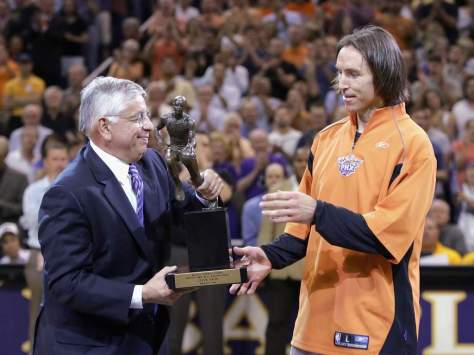
Another player that was robbed of an MVP award due to his team’s poor record is Kobe Bryant, former Los Angeles Lakers shooting guard, during the 2005-2006 NBA season.  Steve Nash, who led the Phoenix Suns to 54 wins and a Western Conference finals berth, averaged a double-double in points and assists and was surely deserving of garnering some support for taking home the award.  However, Bryant was an unstoppable force that opposing defenses could not contain and went on to average over 35 points per game while also grabbing 5 rebounds and dishing out 5 assists a game. Bryant’s Lakers finished with seven less wins than Nash’s Suns and did not make it past the first round (ironically losing to the Suns in Game 7), and because of this, he was penalized for not having as good of a supporting cast in LA as Nash in Phoenix.  Bryant’s best supporting players were Lamar Odom, Smush Parker, Chris Mihm and Kwame Brown.  Besides Odom, a casual NBA fan would have no idea who these players were, while Nash was playing alongside All-Stars such as Shawn Marion and Amar’e Stoudemire.  Thus, the Lakers surely would not have even come close to securing a playoff berth had it not been for Bryant’s otherworldly season. Because Bryant did not have the same talent that Nash had around him, he was overlooked and Nash took home the MVP.
6ffe7b569e2ae49ec9ae5b10ca12b563580a6082_hq.jpg

Team performance is the most important aspect of a successful sports franchise, but in terms of deciding who really is the MVP of any professional sports league, I believe that the question of what would this team be like if a player were not in the lineup every night should be asked.
 

Rafael Devers: The Solution

On paper, the Boston Red Sox might just have the most talented roster in all of Major League baseball. With a golden glover (Betts) and two potential golden glove winners (Bradley Jr. and Benintendi) patrolling the outfield, two former all-stars holding down the middle infield and a pitching staff that features the likes of Chris Sale, David Price, Rick Porcello and Craig Kimbrel in the closer role, it’s hard not to picture this team competing for a world championship.  After a slow start to the season, highlighted by an initial record of 21-21, the Red Sox began to heat up going into the All-Star break.  From top to bottom, the bats really started to produce, and guys like Drew Pomerantz and Rick Porcello turned in some excellent outings. However, this momentum has not carried into the second half of the season as the Red Sox have found themselves 4-7 in their past 11 games, which included a split with the last place Blue Jays and an underwhelming series loss to the Los Angeles Angels. With all of this being said, the Red Sox still find themselves in first place of the AL East with a 2.5-game lead over their arch-rival Yankees. This is promising, considering the Sox have underperformed to this point and will hopefully start to play some better baseball heading down the stretch.

One big shake up that occurred shortly after the all-star break was the release of third baseman Pablo Sandoval. The Red Sox signed Sandoval prior to the 2015 season to a five year, $95 million contract as he was highly regarded as one of the best third basemen in the game. A proven winner with three World Series victories under his belt with San Francisco, coupled with a career slash line of .294/.346/.465, the Sox faithful believed that “The Panda” would hold down the hot corner and help bring a ninth world series championship to Boston. However, this never came to fruition as Sandoval battled injuries and the media buzzed with rumors that Pablo was dealing with an eating disorder that caused him to become very overweight. Prior to his release, Sandoval was batting just .212 in 108 PA and was playing less than stellar defense.  Pablo Sandoval is still owed $49.8 million by the Red Sox through the 2019 season and his contract will surely go down as one of the worst in franchise history.

Pablo-Sandoval-1.jpg
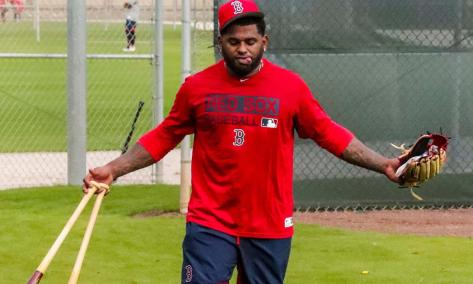
Pablo Sandoval (pictured) was a failure for the Red Sox.

Up to this point, the Red Sox have gone with a platoon at third base which included the likes of Deven Marrero and Tzu-Wei Lin. Both have been serviceable when in the lineup, but the instability at third base is a glaring weakness for this otherwise very strong Red Sox team. Also, former all-star utility man Brock Holt has recently returned from the 60-day DL following his battle with vertigo, but there’s no telling how productive the scrappy left-hander will be the rest of the season.

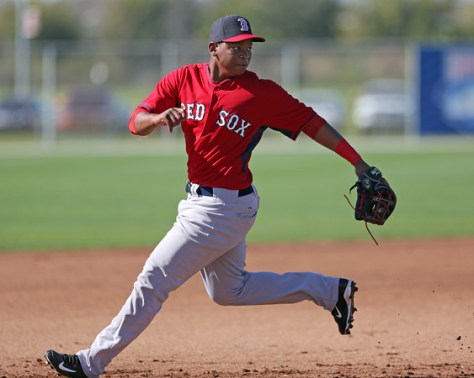
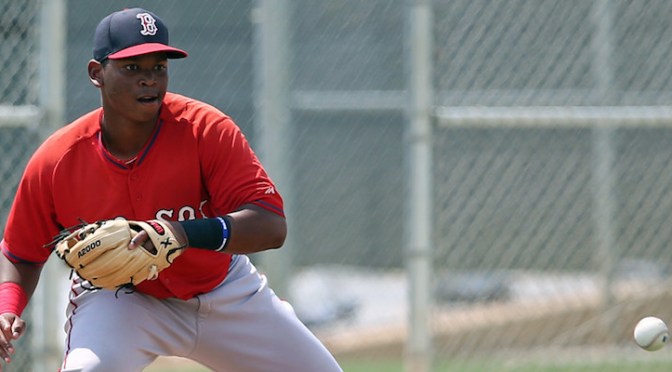
With all of these circumstances taken into account, the Red Sox made the executive decision to call up their top prospect, Rafael Devers, to the big league club following their 3-2 loss to the Angels on Sunday.  People knew that Devers was going to get his shot in the future, but not many were expecting it after only playing nine games in AAA Pawtucket. This automatically makes Devers the youngest player in the MLB, at 20 years and 274 days old at the time of his call-up.

rafael-devers-bb622c88d9436860

The Red Sox signed Devers as an international free agent out of the Dominican Republic shortly after he turned 16 years old.  Scouts have raved about Devers’ big league body to go along with his plus-plus raw power for years. It was only a matter of time for Devers to thrive against professional pitching. Rafael Devers has skyrocketed to the top of the Red Sox organization and has continued to produce at every stop he’s made in the minor leagues. He’s consistently been an all-star at various levels and has participated in the Futures Game twice now. Between AA/AAA this season, Devers has slashed an impressive .311/.377/.578, which includes 20 home runs and 20 doubles.  Not to mention that Devers is consistently facing guys who are three to five years older than him night in and night out.  He’s been an average defender, but his bat will have to carry him if he wants to stay with the big league club for the rest of the season.

Personally, I love this move, given the fact that Red Sox third basemen have hit an embarrassing .224/.284/.307 this year to go along with below average defense.  Something clearly needed to be done and the Red Sox decided to address the need internally, rather than pursuing a trade to acquire the likes of Ian Kinsler or Todd Frazier (recently traded to the Yankees).  I predict that Rafael Devers will plug somewhere into the six-eight spot in the lineup and will be the everyday third baseman moving forward.  Don’t be surprised if you see Devers struggle at first like Yoan Moncada did last season, as it’s a tough transition for power guys to adjust to major league pitching.  Expect to see a bunch of strikeouts and maybe some mental errors here and there, but when you see this 20-year-old square up a baseball and hit it 450ft, you’re going to want to see him in a Red Sox uniform for a long time.  Red Sox nation is going to be totally captivated by the talent that is just surfacing from this kid, and he isn’t even old enough to go out for a beer on Yawkey Way following a big win! So pick up your Rafael Devers jersey now, because we’re all about to witness something special at Fenway Park these next couple months.

030214_1998-M

Just think about a line-up like the one below.  Opposing pitchers are going to have their work cut out for them, as there’s not one easy out in the entire order.  That’s a scary thought for the rest of the league. Throw Sale on the bump and they’re practically unbeatable.

  1. Betts 9
  2. Benintendi 7
  3. Pedroia 4
  4. Ramirez DH
  5. Bogaerts 6
  6. Moreland 3
  7. Bradley Jr. 8
  8. Devers 5
  9. Vasquez/Leon 2