Category Archives: soccer

USWNT Finally Gets Improved Pay

On April 5, 2017, the United States Women’s National Team player’s association and US Soccer finally reached a new collective bargaining agreement that promises better pay and working conditions for their players. While the pay isn’t exactly equal to that of the men’s team, some players could be making double or even triple their original salary. This agreement will last for the next five years, covering the 2019 FIFA Women’s World Cup and the 2020 Tokyo Olympics, finally expiring in 2021. This avoids any potential strike during the tournaments, which US Soccer adamantly wanted to avoid. The new deal ends a battle between the two sides that started in March of 2016. That month, national team players Carli Lloyd, Megan Rapinoe, Rebecca Sauerbrunn, Hope Solo and Alex Morgan filed a complaint with the Equal Employment Opportunity Commission stating that their pay and their working conditions were not nearly fair in comparison to that of the men’s team. On January 17, 2017, the USWNT player’s association underwent leadership changes as Rebecca Sauerbrunn, Christen Press and Meghan Klingenberg became the new representatives, who were determined to get the deal done.
16229507_1408834742502630_4221780280182046720_n
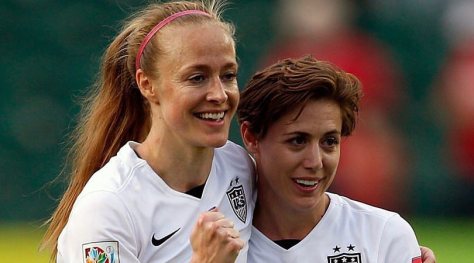
Sauerbrunn (left) and Klingenberg (right) were two of the three players elected to head the Player’s Association as representatives in early 2017.

In 2016, the base pay of a tier 1 national team player who also played in the National Women’s Soccer League was $128,000, without Olympic bonuses. The new agreement has players earning up to $200,000 to $300,000 per year with added benefits including more freedom with endorsements, which could result in additional potential opportunities to make more money.

The new deal comes in after the NWSL (National Women’s Soccer League) announced their partnership with A+E networks which allows one game to be broadcasted on Lifetime Network per week. The NWSL played an integral role in the bargaining process. They will hold US Soccer to continue to pay the salaries of women’s players under the condition that the players must stay committed to the league. Negatively speaking, this leaves the contracts of those playing overseas in question because the European seasons overlap with that of the NWSL. The CBA also states that US Soccer will fund the improvement of NWSL stadiums, facilities and player accommodations. The minimum salary of those in the NWSL is expected to double to at least $15,000, also resulting in an increased maximum salary and salary cap which has not been determined yet.
2062738_big-lnd.jpg

Player’s association representative and USWNT captain Becky Sauerbrunn said, “I think the deal that we got is phenomenal. And I think it’s a great step for the team now but also a great launching point for other CBA negotiations and other eras of this team that will be negotiating.”

She continued to say, “We do believe that going to a pay-to-play model [like the men’s national team] is the future… For us, it was structuring the CBA to let go of some of the security that comes from the national team and placing that more on NWSL. I would say that’s kind of where we were meeting in the middle.”


In a podcast with Sports Illustrated’s Grant Wahl, Sauerbrunn said, “We’re trying to figure out where women’s soccer is going, so we may not have the same exact structure as the men. So equal isn’t the right word. It would be equitable, because we are asking for a different structure.”

The CBA of the soccer team came just days after the the Unites States Women’s Hockey team won their own battle for equal pay. The hockey team threatened to boycott the Women’s World Championships, but reached a deal the day before the competition began, going on to win gold. Although the financial terms of the agreement have not been released to the public, it has been stated that there will be more of an effort from USA Hockey to improve women’s and girl’s hockey in the future.

170315102116-us-womens-hockey-1024x576

Slowly but surely, the battle for inter-gender equality in professional sports is moving in the right direction, and it is just a matter of time before every other professional women’s sport follows suit.

Venezuelan Soccer Growing Rapidly in Latin America

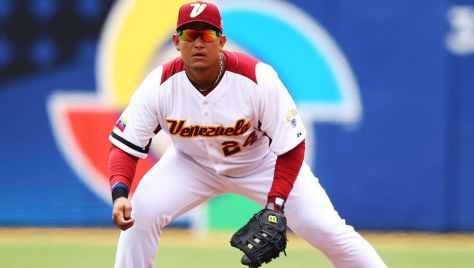
One of the most vivid memories of my childhood in Venezuela was undoubtedly the visible enthusiasm that I could see in the face of every Venezuelan, as the MLB’s opening day would approach. Nothing made any Venezuelan sports fan happier than seeing one of their own play on the enormous stage of professional baseball. Baseball was and has always been the national sport. This season’s Opening Day featured close to 80 Venezuelan baseball players on Major League rosters. Some of the most well known Venezuelan players in today’s game include Miguel Cabrera, Felix Hernandez, Carlos Gonzalez and Jose Altuve, to name a few.

577e672c67b42ee6a4000001
Miguel Cabrera (pictured) has been a staple of excellence in his baseball career, both in the MLB and on the national team.

To contrast, soccer in Venezuela has never been as important to the country as it has been to neighboring powerhouses like Brazil, Argentina, Chile and Colombia. However, the most popular sport in the world has been growing at a fast and steady rate since the late 1990s. In the early 2000s, under the coaching of Richard Páez, the Venezuelan national team began to make a name for themselves. Some key victories against well-known teams like Uruguay, Chile, Perú and Paraguay cemented the idea that Venezuela could compete with the best in South America. These triumphs not only gave the country something to feel proud about and look forward to but also marked the time in history that the team earned the nickname of La Vinotinto (translating to “the burgundy,” which reflects the color of the national uniform).

The first big Venezuelan soccer player, Juan Arango, began his career in his home country, but quickly found himself moving to more competitive leagues. He then spent over fifteen years playing in Mexico, Spain and Germany. Arango was the first Venezuelan player to play in the exponentially more intense European competition. After his departure, players were inspired and even more motivated to follow in his footsteps. More Venezuelans started getting recruited by other countries, creating a proud sense of nationalism, and attracting more locals to watch soccer. People closely followed the paths that were taken by the country’s players.

121016CR023.jpg
Juan Arango (pictured) paved the way for fellow Venezuelan soccer players to play outside of Latin America.

This was also the moment in time that I personally began to closely follow our national team. Even if it was simply a friendly match, it felt like the country was watching a final of the World Cup or the UEFA Champions League. Despite the fact that the country is going through one of the biggest financial crises and security problems of all time, the sense of pride that this sport has been able to create has revitalized Venezuelans all across the country.

Many other players such as West Brom striker Salomón Rondón and Juventus midfielder Tomás Rincón have followed in Arango’s footsteps. Rondón is only twenty-seven years of age and has managed to become one of the most prominent underrated strikers in the English Premier League. As a consistent performer and veteran on the national stage, Tomás Rincón is known to be one of the best midfielders that Venezuela has ever been able to produce.

Tomas-Rincon-Juventus-VERSION-FINAÑ-730x410
Tomás Rincón (pictured) plays for Italian club Juventus, one of the biggest clubs in the world.

Soccer in Venezuela is growing at a fast rate due to the fact that more and more players are striving to play abroad and eventually obtain opportunities to showcase their skills on larger stages. Even though the national team has never qualified for a World Cup, the country’s younger teams such as the U-20 team will be playing on the international stage in Korea Republic 2017. This shows the emerging young talent that is coming out of the country.

On the other hand, two of my favorite footballers that are continuously growing as players and seem to show a lot of promise are Josef Martínez and Adalberto Peñaranda. At only 23 years of age, Martínez plays as the main striker for new MLS team Atlanta United FC and has scored five goals in his first three matches for the young club. Martinez has great mobility and capacity, and has the scoring touch to distinguish himself from his peers. If he stays fit, he will definitely be one of the key players in the new generation of Venezuelan soccer.

j-martinez-6722856205
Josef Martínez (pictured) has been on fire to start the MLS season.

19-year-old youngster Adalberto Peñaranda plays for Malaga FC on a loan from English club Watford. Peñaranda has also been showing a lot of promise despite his lack of experience at such a high level of soccer. He still has a lot to prove, but his ability to create in the open field and his ability to play off of other players on his team shows that he has the potential to eventually become a great player. If he can work on his ability to finish in front of goal, he will definitely be remembered as one of the greatest players to put on the Venezuelan national team uniform.

Every Venezuelan looks forward to and hopes for national improvement, economically and beyond. The crisis and insecurity have caused many aspects of the country to deteriorate, while also preventing other aspects to flourish. While this has been an issue for many years, Venezuelans continue to strive and keep their hopes up. Seeing La Vinotinto qualify to the FIFA World Cup would surely boost the morale of Venezuelans all across the country and the world. I don’t see this happening in the upcoming World Cup, but in eight years, we could very well be playing on the biggest stage in soccer, just as we did a couple of months ago in the World Baseball Classic.