All posts by jeromeb617

Passion versus Profit – the Plague of the Chinese Super League

The following is a nonsensical scenario:

It has just been announced that Isaiah Thomas, the point guard for the Boston Celtics currently in the best form of his career, is leaving the National Basketball League (NBA) to play professional basketball in the Philippine Basketball Association (PBA) on a three-year, 80-million-dollar contract. Suddenly, a number of other great players in the NBA are following suit to play in the PBA for similar fees.

You’re probably scratching your head, thinking, “…the Philippines?”

Trust your instinct, my friend, because you were right: this would never happen in a million years. The NBA is undisputedly home to the highest standard of basketball in the world, and attracts the best basketball players from around the world who are looking to maximize their potential. For a top-quality player like Isaiah Thomas to go to such a minuscule league would be considered the utmost lucrative transfer in the history of the NBA.

Alas, at the end of the day, money talks. A lot.

In fact, it seems to be talking more and more in soccer than in any other sport in the world at this moment in time. Sadly, this hypothetical Isaiah Thomas transfer to the PBA is precisely what is happening in the sport of soccer. Except, instead of the Philippines, soccer fans find themselves scratching their heads, thinking, “…China?”
download.jpeg

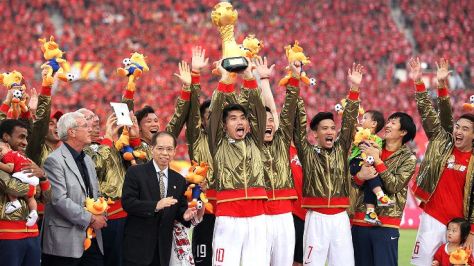
Believe it or not, in just the last few months, there has been a wave of highly regarded soccer players moving from various European leagues to the Chinese Super League (CSL).

This wave of European-based talents to China is cancerous to the sport of soccer.

It is important to note that Europe is to soccer as the United States is to basketball in the sense that Europe is home to the highest standard of soccer in the world. In order for the young talents around the world to be taken seriously as top-quality players, they must be able to take their performances in their home countries and perform at the same level in Europe, especially in the five biggest European leagues (England, Spain, Germany, Italy, France). So if you’re playing in Europe, why would you want to leave?

Well, just ask Alex Witsel, Oscar or Carlos Tevez, just to name three of the many culprits who made the move to China.

What you won’t hear in any of their answers is a rave review of the Chinese soccer scene.

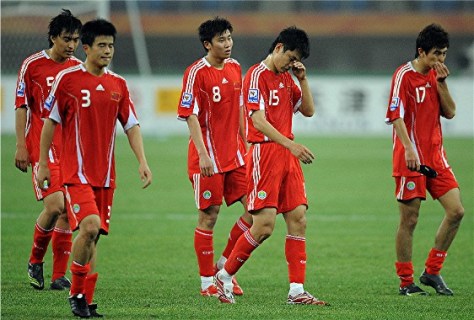
The first professional soccer league in China was founded in 1994, but it quickly became clear that it was riddled with match-fixing, gambling and corruption. Professional soccer in China then underwent a major reformation, which resulted in the creation of the CSL in 2004. Although the CSL consists of 16 teams, Guangzhou Evergrande has won the last six league titles, highlighting the non-existence of competition in China. On the international level, China has never been able to compete with the rest of the world. Since FIFA, the governing body of international soccer, created the world ranking system for international teams back in 1992, China has averaged a ranking of 72nd. Furthermore, China has only qualified for one World Cup in its history back in 2002, where they tumbled out of the group stage, losing all three of their games and conceding nine goals in the process.
Chinese-Soccer-Team.jpg

So no, these players are not leaving to improve their game, because the standard of soccer in China is minuscule in comparison to Europe. What you will hear in (at least) one of their answers, though, is money.

Up until January of this year, 28-year old Belgian midfielder Axel Witsel, had spent his professional career playing in Belgium, Portugal and Russia. Witsel had not yet breached the realm of the top five leagues, but he had long been good enough to cope with the highest level of competition. Then, following a solid Euro 2016 performance last summer, it seemed as though he would finally get to prove his worth when Italian powerhouse Juventus showed a massive interest in signing the Belgian. Everything was lined up perfectly for Witsel to make that final step up in his career.

That is, until Tianjin Quanjian F.C. of the CSL reached out to him offering a four-and-a-half-year contract with an annual salary of 19.4 million dollars.

Witsel was quickly on his way to China. When asked about his decision, Witsel did not beat around the bush. He explained that, “It was a very difficult decision because on the one hand there was a huge, top club in Juventus, but on the other hand there was an irresistible offer for the future of my family.”

I personally cannot decide whether to admire or despise his honesty, but regardless of how you feel about his response, the reasoning remains the same.

Money talks. A lot.

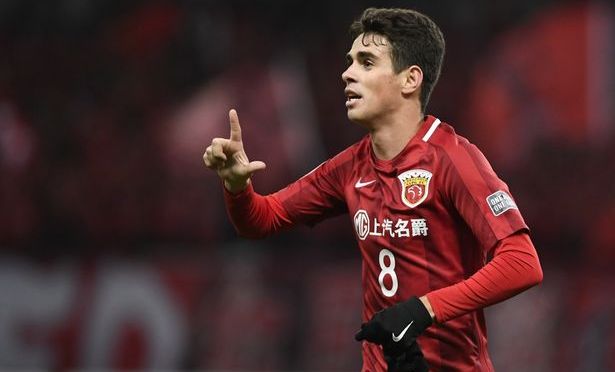
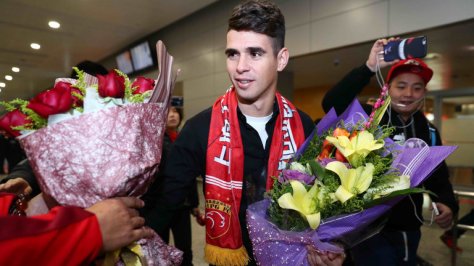
Another player who listened to the money was 25-year old Brasilian former Chelsea midfielder Oscar who had far more potential than Axel Witsel. This is the same Oscar who, at 21 years old in the Champions League, made a fool out of Italian legend Andrea Pirlo with a world-class cruyff turn and then proceeded to do the same to Pirlo’s fellow Italian legend and teammate Gianluigi Buffon with a world-class finish into the top right corner.

Now, fast forward four years to the arrival of Antonio Conte as Chelsea’s new manager last summer. Oscar had seen a drop in form even before Conte’s arrival, and he fell even farther down the pecking order with Conte’s revolutionary 3-4-3 formation after starting the first five games of the season. Despite his unfortunate form at Chelsea, Oscar could have left and been a starting player for countless teams across Europe.

But alas, money talks. A lot.
skysports-oscar-chelsea-shanghai-brazil-chinese-super-league_3862774.jpg

Instead of spending the best years of his career playing for a top-level European side, Oscar decided to play for Shanghai International Port Group F.C, where he will be making roughly $500,000 a week. That breaks down to about $71,000 a day, $3,000 an hour, and $50 a minute. Those numbers speak for themselves. I know, I’m furious too. A massive waste of talent and money.

Last but not least, we have 32-year-old Argentine striker Carlos Tevez. Tevez is a different case than that of Axel Witsel and Oscar because he did not actually go from Europe to China. Also unlike Witsel and Oscar, Tevez had already thoroughly proven himself at the top level. He was a key starting player for Manchester United, the biggest soccer team in the world, as well as their rivals Manchester City, along with Juventus. Instead of going to China and much to the adornment of the global soccer community, Tevez left Juventus to play for his boyhood club Boca Juniors in Argentina where it all started. His return looked like utter pandemonium, and Tevez was set to retire as a Boca Juniors player like a true legend.

But alas, money talks. A lot.

Shanghai Shenhua from the CSL offered Tevez a two-year, $91-million-dollar contract that would officially make him the highest paid soccer player in the world, despite his being well past his prime. That breaks down to about $760,000 a week, $108,500 a day, or $4,500 an hour. After some time of publicly-professed deliberation, Tevez too was on his way to play for Shenhua. This was the same man who, back in 2010 said, “Football is only about money, and I don’t like it.” Funny how times change, huh?

IMG_6843.JPG

Well, actually, it’s quite the tragedy.

Again, the Chinese Super League is cancerous towards the sport of soccer. It is hanging crisp dollar bills on a string above the heads of these world-class footballers and baiting them right over the edge of the cliff and into the abyss of irrelevance where they will happily rot in their riches. It is showing fans that, ultimately, players care more about the money than the people who pay to support them.  It is teaching young, aspiring soccer players around the world that monetary success is ultimately more important than playing at the highest level. We as a culture seem to be forgetting what makes the game so beautiful. We play with our feet, but we move with our souls. We live for this game because we love it. Realistically, like back in the day, money should be the last thing we play for.

Thankfully, in the end, we as a soccer community don’t need these players, nor do we want these players. They represent a minuscule portion of the immense pool of talent that exists both in the world and in Europe specifically, and their selfish attitude is not something that the young soccer community needs. There is no way of stopping the offers coming in from the CSL, so all we can really do as fans is to entrust in these soccer players that they remember what the game is played for.

But alas, money talks. A lot.

 

Ten Years After David Beckham

Ten years ago as of last Wednesday, the Los Angeles Galaxy purchased David Beckham, an English soccer player from Real Madrid on a five-year contract worth 250 million dollars. Many considered his hefty transfer to be the precursor of a significant breakthrough in the standard and the popularity of soccer in the United States, both within Major League Soccer (MLS) and for the Men’s National Team. After all, Beckham was at the time one of the most marketable athletes in all of sports since the turn of the century, and more importantly the first world-class soccer player in the MLS era. But looking back now, is there a definitive ‘before’ and ‘after’ with David Beckham’s move to the MLS?

Well, right now, the standard of soccer in the United States is reminiscent of an awkward dancer: they more or less have the steps (the system) down, but the rhythm (culture) still lags far behind.

The United States is undoubtedly still learning the “steps” of soccer. While there have been multiple professional soccer leagues in the United States in the past, none of them were able to remain afloat for even two decades, ultimately due to a lack of popularity. Considering that the MLS was founded 24 years ago in 1993 and is still growing, it is all but safe to say that the MLS is here to stay. After another decade of development that has seen the addition of nine new professional teams to the league, with four more teams being added by 2018, the MLS is quickly expanding its presence across the country. This, combined with the increasing number of American player development academies clearly signifies the United States’ ambition to breed world-class players of their own both within the MLS and for the national team.

One must remember, however, that learning the steps is futile if you have no rhythm.

For over a century, the United States has had a thriving culture in several sports, but that list has never included soccer. Although 24 years is a long lifetime for a professional soccer league in the States, it is minuscule in comparison to that of America’s mainstream sports. The American professional baseball, basketball, football and hockey (Canadian-American) leagues have existed for 114, 71, 96, and 99 years respectively, meaning that Americans have been watching and playing these longstanding sports since long before soccer meant anything to the general public on a domestic level. In doing so, the “steps” have long been ingrained into the minds of many of these kids, some of whom then utilize them in pursuing a competitive sports career. More importantly, these experiences as both observers and participants has helped to develop a culture within each of these sports that has collectively become a part of the identity of the United States. The entertainment is there, the prestige is there, and the experience is there.

There is rhythm flowing through the veins of these American sports fans.

The rhythm of soccer, on the other hand, has always felt foreign to the United States, because, well, it is. Players almost exclusively use their feet to play, while feet are rarely used as the primary means of operation in mainstream American sports. Regular season games can end in a 0-0 tie, as opposed to the extra innings or overtime period(s) that guarantees victory to one specific team. Professional teams can compete in up to five different competitions within the same season, whereas in the States, there is always a regular season followed by playoffs, all for one trophy. On a global scale, despite the incredible success of the women’s national team, the more followed men’s national team has never gotten past the quarter-final of the FIFA World Cup, the most coveted trophy in the world of soccer.

Furthermore, even though soccer is the most popular sport in the world, it is also the one sport in which the United States does not own bragging rights. While the American professional leagues of the aforementioned sports are each considered the best professional leagues in the world, this is not the case in soccer. The best soccer players in the world aim to play in Europe, which is widely considered the highest level of competition in the world. Unlike American kids who pursue a multitude of sports at their own will, so many children from around the world grow up watching only soccer, establishing an innate sense of dedication towards learning the “steps” and adopting the “rhythm” of the beautiful game.

With that being said, the MLS is decades away from coming even the slightest bit close to the standard of soccer that exists across the top leagues in Europe. David Beckham’s move to the LA Galaxy in 2007 acted as an invitation to long-established world-class talents to play in the MLS towards the ends of their career, after already being past their respective primes. Household players including Didier Drogba, Tim Cahill, Ashley Cole, Jermaine Defoe, Steven Gerrard, Frank Lampard, Kaka, Thierry Henry, Alessandro Nesta and Andrea Pirlo have all played in the MLS since Beckham’s move in 2007. While the addition of such famous soccer players has helped increased the appeal of the MLS to Americans, it does not reflect positively on the standard of the league nor does it help to increase it.

On the other side of his career, now 18-year old Christian Pulisic from Hershey, Pennsylvania, signed a professional contract at the age of 16 with German club Borussia Dortmund, where he has already received regular playing time, scoring multiple goals for his team. Moving to Germany was an easy decision for Pulisic, who is now considered to be one of the brightest young talents to come out of the United States, for he knew that playing in the United States would only be detrimental towards reaching his untapped and arguably world-class potential.

3hbqktf


So what can we as Americans do to develop the rhythm of soccer?

This is the only time that you will ever see me saying this: Watch more television. In 2013 and 2014, NBC Sports Cable Network aired two seasons of the Premier League, the professional soccer league in England, which is widely considered to be the best professional soccer league in the world. Viewership of the Premier League increased considerably between those two seasons, inspiring NBCSN to sign a $1 billion contract with the Premier League for exclusive broadcasting rights. Signing such a large contract serves as a statement by major American television networks, considering the fact that they recognized the development of a long-term increase in the popularity of European soccer in the United States.

It has been stated time and time again that watching top-level soccer does indeed help aspiring players to increase their “soccer IQ”, or their knowledge of the mechanics of the game. As more and more Americans tune in to watch the fast-paced excitement of the Premier League, I believe that their continued interest will gradually help Americans in developing that rhythm that has been lacking in American soccer for so many years. Specifically, as more children watch the highest standard of soccer, they will be more in touch with the game on a global scale, and those kids will be increasingly motivated to become a great talent themselves.

The only thing we can do other than study up is to keep young talents like Christian Pulisic at home, so that we can build a powerful professional league upon a foundation of homegrown talent, rather than upon the temporary stints of past-prime foreign soccer players.

Bye, Bye, Beckham

With the thin culture of soccer that had existed in the United States as well as the young age of the MLS at the time, David Beckham’s transfer to the LA Galaxy in 2007 was never going to make a significant short-term impact on soccer in the States. His move did not have any evident influence the expansion of the MLS, or on the increasing number of player development academies across the country. While I do not necessarily believe it myself, one could argue that he did have a long-term impact on soccer in the United States simply by signing a contract. His move to the MLS was one of the biggest sports publicity stunts of the century, and one that may have helped catalyze in some small way a mainstream American interest in the sport of soccer,

With or without the help of David Beckham, here we stand in 2017 as an awkward dancer in the world of soccer.